The Career Compass
Architecting a Global UX Framework for Talent Retention and Strategic Growth
CLIENT: Backbase
SERVICES: UX Career Pathing, Competency Matrices, Design Leadership Framework
The Mission: Defining Excellence
Timeline
March – November 2023
Stakeholders
Gaia Armellin (CS Principal UX), Backbase Delivery Director Customer Success, Backbase Global HR Business Partner, Backbase EVP Customer Success
At a certain scale, “Senior” becomes a subjective term. In a global team of 50 designers, without a standardized framework, performance reviews become biased and career growth becomes a mystery. My mission was to design the Global CS UX Career Framework, a transparent, objective system that defined what excellence looked like at every level.
- The Goal: Align individual aspirations with the bank’s high-stakes delivery needs.
- Objective: Replace ambiguity with a measurable competency matrix.
The Challenge: The Friction of Subjectivity
Creating a career path is a high-stakes emotional task. I had to navigate deep structural friction:
- The “R&D” Shadow: Our team was originally tethered to R&D standards. But Customer Success (CS) design is different. It requires higher stakeholder management, client-facing diplomacy, and “on-the-ground” agility. I had to develop a framework that respected the unique DNA of CS UX.
- The Seniority Ceiling: We had talented designers hitting “invisible ceilings.” Without a defined path to Lead or Principal, we were at risk of losing our best mentors to competitors.
- The Consensus Trap: Aligning HR, the EVP of Customer Success, and global Design Leads meant everyone had a different definition of “Value.” I had to move from a designer to a Mediator, distilling a dozen opinions into one bulletproof system.
The Strategy: Architecting the Ladder
We didn’t just list titles; we mapped out the Somatic and Technical journey of a designer.
- The Competency Audit: I broke down the role into three pillars: Craft (The How), Strategy (The Why), and Leadership (The Who). This ensured that a “Lead” wasn’t just a fast pixel-pusher, but a strategic force.
- The Iterative Stress-Test: I ran “mock promotion cycles” using the draft framework. We tested it against real employee profiles to see: Does this actually help us identify who is ready for the next level?
- The Transparency Protocol: We moved the framework out of hidden HR folders and into a living, visual document. This turned the “Career Path” into a conversation-starter between managers and reports, rather than a once-a-year surprise.
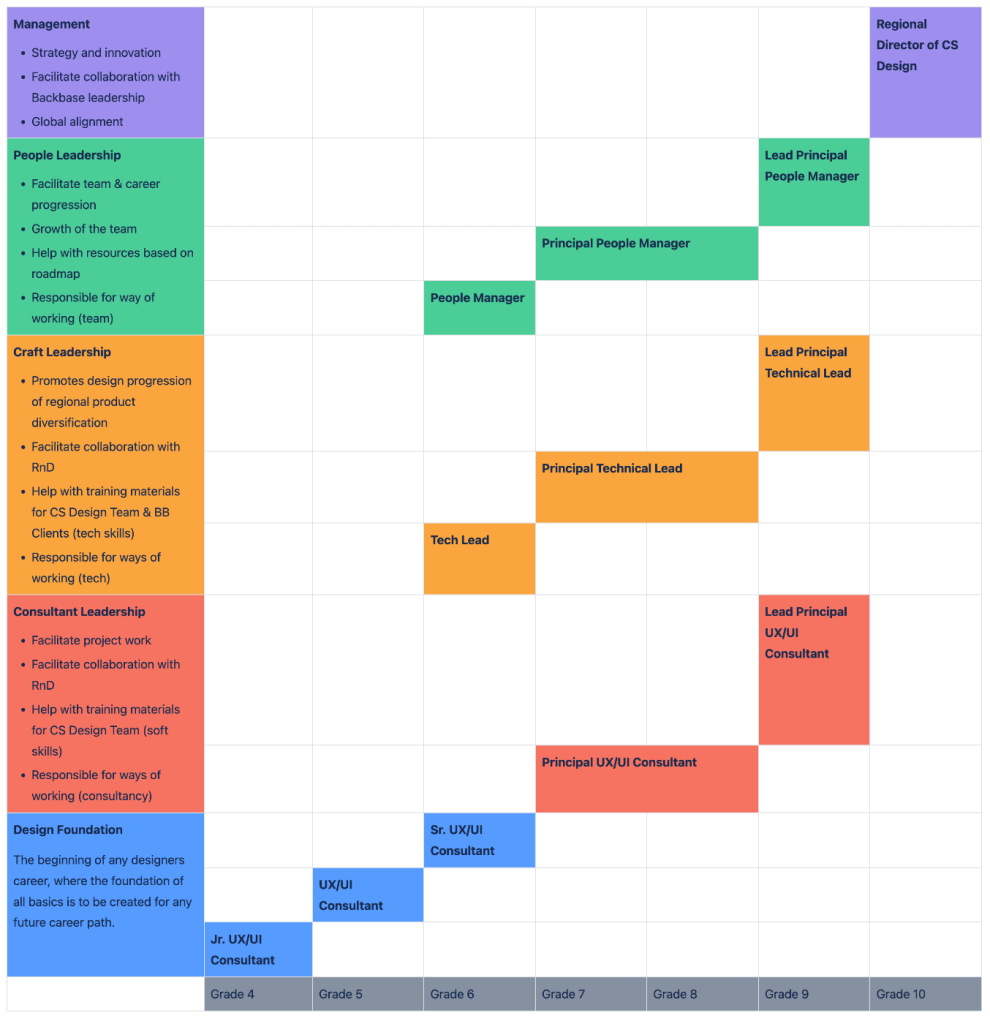
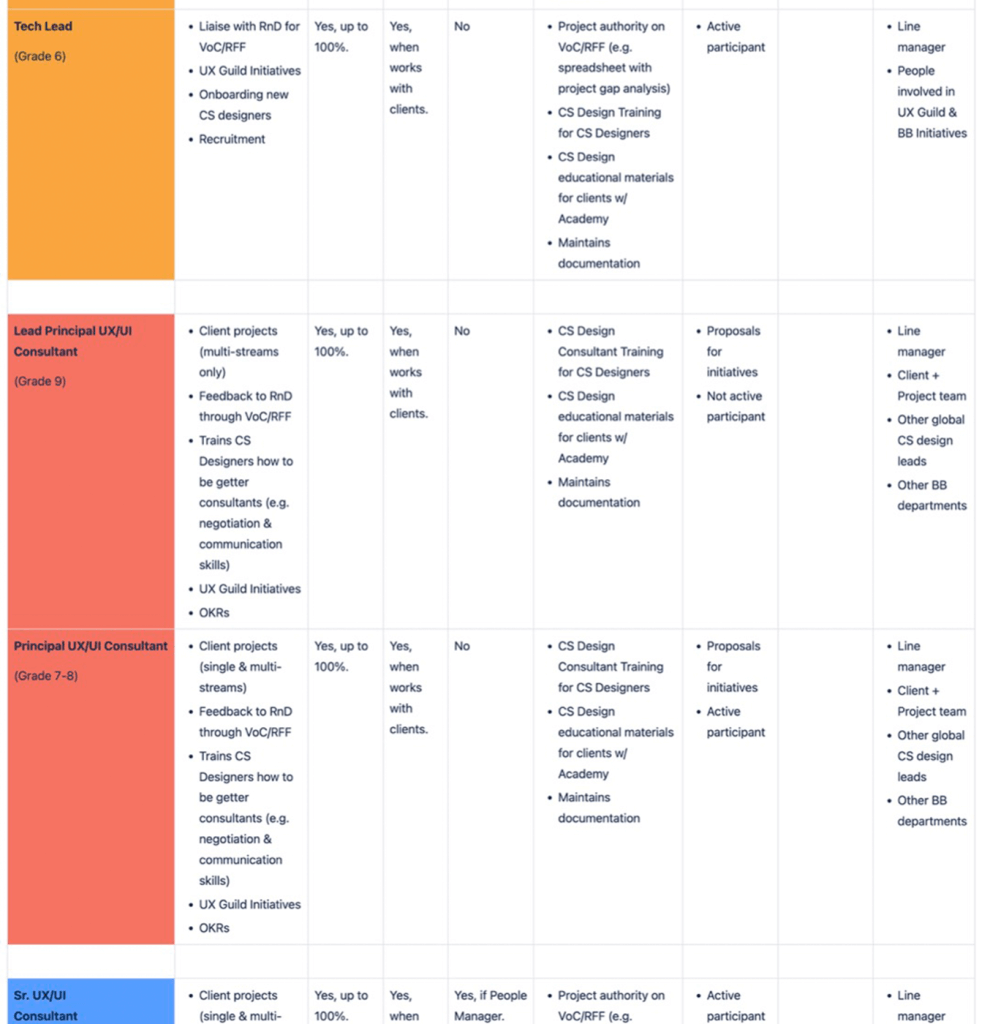
samples of deliverables
The Results: Impact & Organizational Maturity
The framework successfully moved from a conceptual draft to an operational reality, becoming the “Gold Standard” for the CS Design organization.
What We Delivered:
- The CS UX Competency Matrix: A granular breakdown of expectations for Junior, Mid, Senior, Lead, and Principal roles.
- The Personal Development Blueprint: A template for designers to map their current skills against their “dream role,” highlighting the exact gaps they needed to bridge.
- Standardized Review Loops: A shift from “I think you’re doing great” to objective, data-backed performance conversations.
- Internal Alignment: Secured 100% buy-in from HR, the Delivery Director, and all Global Design Leads, proving the framework’s operational validity.
The Structural Evolution:
- Organizational Boundaries: While the framework successfully optimized the team’s growth up to the Principal level, the organization’s current hierarchy was not yet positioned to formalize a “Director of Design” tier within the Customer Success department.
- The Legacy: Despite the structural block at the top, the framework remained in place, informing the growth paths of the 50+ designers below that ceiling.
- Talent Safety: Reduced “growth anxiety” across the 50-person team. Designers stayed because they finally saw a future where they belonged.
The “Must-Haves” for the Future
This project provided a masterclass in the intersection of Design Systems and Organizational Design:
- Systems Outlast Structures: A well-designed framework provides value even when the hierarchy is static. My focus was on ensuring the team had a path, regardless of my own.
- Standardization is the Mother of Fairness: When the rules are the same for everyone, bias has nowhere to hide.
- The Leader as an Architect of Transition: Part of Staff-level leadership is recognizing the “Natural End” of a mission. Building a system, proving its worth, and then handing it off is the ultimate sign of a successful tenure.
- Alignment is a Multi-Level Game: Success requires aligning the team (for adoption), HR (for legality), and Executives (for structural change). Each requires a different language and a different level of integration.
